How to Stay Consistent with Working Out (Even When You're Busy)
Tired of the start-and-stop cycle with your fitness routine? As a health coach for busy women, I'm sharing my most practical, real-world tips on how to stay consistent with working out, no perfection or gym membership required.
Why Is It So Hard to Stay Consistent with Working Out?
It's hard to stay consistent with working out because we often set unrealistic goals, choose exercises we don't enjoy, and let an 'all-or-nothing' mindset derail us when life gets in the way. If this sounds familiar, please know you are not alone. So many of the 500+ women I've coached have come to me with this exact struggle.
Let's break down the most common consistency hurdles:
- All-or-Nothing Thinking: You plan to work out five days a week. A busy Monday means you miss day one. By Tuesday, you feel like you've already failed, so you think, "I'll just start again next week." This black-and-white thinking is the biggest enemy of long-term progress.
- Unrealistic Expectations: We live in a world of instant gratification, and it's easy to get discouraged when you don't see massive changes after two weeks. Lasting results take time, and focusing only on the end goal can make the daily process feel like a grind.
- Sheer Exhaustion: As a busy woman, you're likely juggling a career, family, social life, and a thousand other responsibilities. At the end of the day, the idea of a grueling workout can feel more like a punishment than a form of self-care.
- You're Not Having Fun: If you dread every single workout, you're not going to stick with it. Forcing yourself to run on a treadmill when you hate running is a recipe for quitting. The best workout routine is one you don't have to force yourself to do.
How Can I Build a Workout Routine That Actually Sticks?
You can build a workout routine that sticks by starting small, scheduling it like an important appointment, choosing movement you genuinely enjoy, and focusing on how it makes you feel. It's about creating a system that supports you, rather than relying on motivation, which comes and goes.
Here are my go-to strategies for building a truly sustainable habit:
- Start Ridiculously Small: If you're going from zero workouts a week, aiming for five is a huge leap. Instead, aim for two 20-minute sessions. The goal is to make it so easy that you can't say no. Once that feels like a non-negotiable part of your week, you can add more.
- Schedule It: Don't just hope you'll "find time." You won't. Look at your calendar for the week and block out your workout appointments. Treat them with the same importance as a meeting with your boss. This is your meeting with yourself.
- Find Your Fun: Movement shouldn't feel like a chore. Explore different options! Maybe it's a dance class, a hike with a friend, a challenging strength session with dumbbells at home, or a yoga flow on YouTube. When you find something you actually like, consistency becomes effortless.
- Focus on How You Feel: Instead of obsessing over the scale, pay attention to other benefits. Do you have more energy? Are you sleeping better? Do you feel stronger carrying in the groceries? These non-scale victories are powerful motivators that show up long before the physical changes do.
- Habit Stack: Link your new workout habit to an existing one. For example, "Right after I brush my teeth in the morning, I will put on my workout clothes." This simple trick from James Clear's book Atomic Habits removes one of the biggest barriers: getting started.
What's a Good Beginner Workout I Can Do Anywhere?
A great beginner workout you can do anywhere is a full-body circuit using just your bodyweight or a pair of dumbbells. The key is to focus on compound movements—exercises that work multiple muscle groups at once—to get the most bang for your buck in a short amount of time.
This workout is designed to be efficient, effective, and totally adaptable to your fitness level and equipment. You can do it in your living room in less than 30 minutes.
20-Minute Full-Body Strength Circuit
Perform each exercise for the recommended number of reps, then move to the next with minimal rest. After completing all five exercises, rest for 60-90 seconds. Aim to complete 2-3 full rounds.
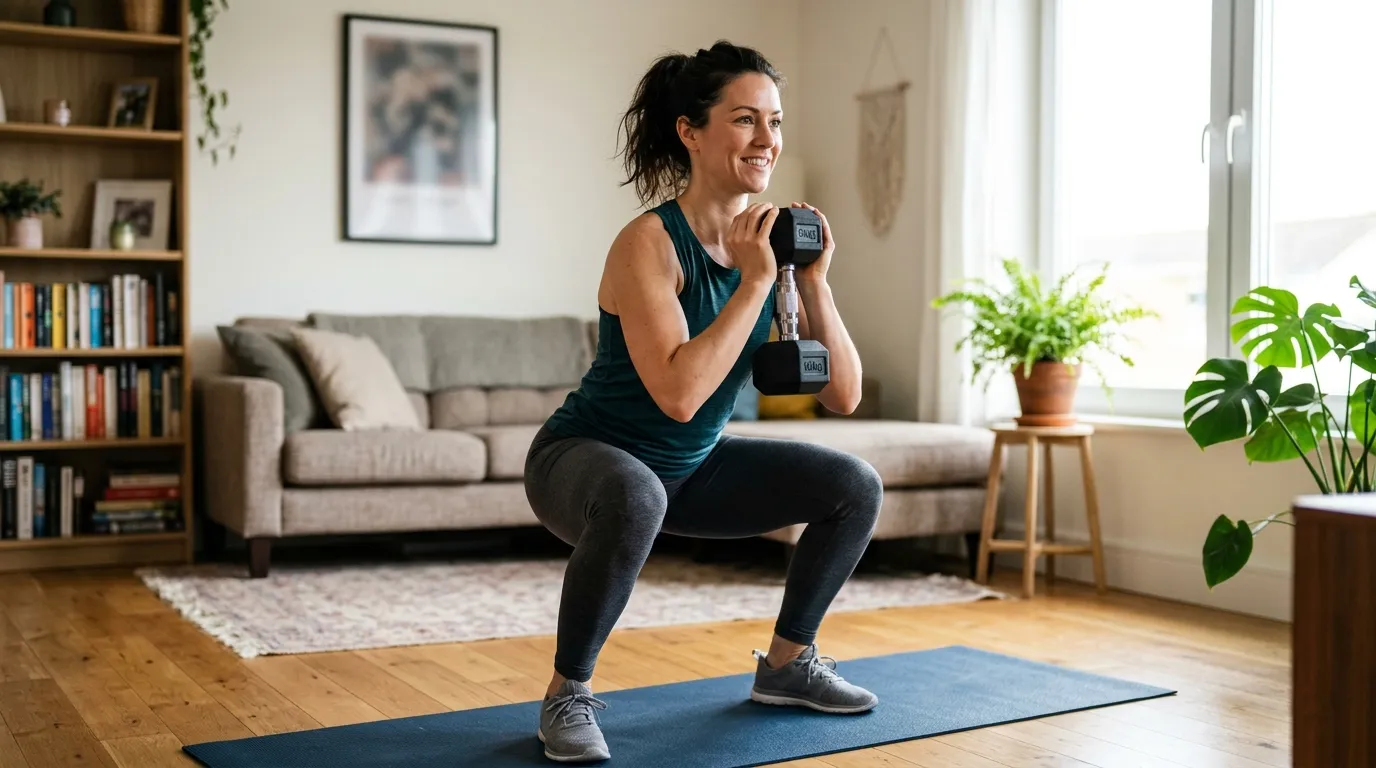
- Goblet Squats (or Bodyweight Squats): 10-12 reps. Hold one dumbbell vertically against your chest. Keeping your chest up, lower into a squat as if sitting in a chair. Press through your heels to return to the start.
- Push-ups (on knees or toes): 8-10 reps (or as many as you can with good form). Keep your core engaged and your body in a straight line from your head to your knees/heels.
- Dumbbell Rows: 10-12 reps per arm. Hinge at your hips with a flat back, supporting yourself with one hand on a bench or chair. Pull the dumbbell up towards your chest, squeezing your shoulder blade.
- Glute Bridges: 15-20 reps. Lie on your back with your knees bent and feet flat on the floor. Squeeze your glutes to lift your hips toward the ceiling.
- Plank: Hold for 30-60 seconds. Keep your body in a straight, strong line. Don't let your hips sag or rise too high.
A note for beginners: Focus on your form above all else. If something doesn't feel right, stop. It's better to do fewer reps with great technique than many with poor form. Start with 2 rounds and see how you feel!
How Do I Overcome a Motivation Slump?
You overcome a motivation slump by shifting your focus from feelings to habits, tracking non-scale victories, and having a backup plan for low-energy days. Motivation is a fickle friend; discipline and habits are what carry you through when you're just not feeling it.
Even as a coach, I have days where I don't want to work out. It's completely normal. Here’s what helps me and my clients push through:
- Have a '5-Minute Rule': Tell yourself you only have to do it for five minutes. More often than not, once you start moving, you'll want to finish. And if you still don't feel it after five minutes? Give yourself permission to stop. You still kept the appointment with yourself.
- Create a 'Movement Menu': Make a list of activities you can do based on your energy level. High energy? A dumbbell circuit. Medium energy? A brisk walk or yoga flow. Low energy? A gentle 10-minute stretch. This way, you always have an option and never have to skip entirely.
- Remember Your 'Why': Why did you start this journey? To have more energy for your kids? To feel strong and confident in your body? To manage stress? Reconnect with that deeper reason when your motivation wanes.
- Find Accountability: This could be a friend you text after a workout or a coach who checks in on you. Knowing someone is in your corner can be the push you need.
Try this week:
- Schedule three 20-minute "movement appointments" in your calendar right now.
- Choose one "bad day" backup plan (e.g., a 10-minute walk around the block).
- After one workout, write down a non-scale victory, like "I had more energy this afternoon" or "I felt proud for showing up."
What Role Do Sleep and Energy Play in Consistency?
Sleep and energy are foundational for workout consistency; without enough quality sleep and proper nutrition, you won't have the physical or mental energy to show up for your workouts. You can't expect your body to perform if you're not giving it the basic resources it needs to function.
According to the CDC, regular physical activity can improve sleep quality, but the relationship is a two-way street. Poor sleep can seriously sabotage your fitness goals. When you're sleep-deprived, your body craves high-sugar, high-fat foods for a quick energy boost, your perceived effort during exercise is higher (making workouts feel harder), and your motivation plummets. Aiming for 7-9 hours of quality sleep per night is one of the best things you can do for your fitness journey.
Similarly, food is fuel. Many women I work with come from a background of restrictive dieting, where they were taught to eat as little as possible. This approach backfires because it leaves you with no energy to exercise or even get through your day. My coaching philosophy is built on flexible nutrition—adding more nutrient-dense foods like protein and fiber, without making any food group off-limits. When you're properly fueled, you have the energy to crush your workouts and the mental clarity to make choices that serve your goals. If you need ideas for delicious, energizing meals, my Meal Library has over 100 recipes to get you started.
How Madison Hansen Health Coaching Helps You Stay Consistent
At Madison Hansen Health Coaching, I help busy women build lasting consistency by creating fully customized training and nutrition plans that fit their real lives, providing true one-on-one accountability and support. My goal is to teach you the skills you need to maintain your results for life, so you don't have to depend on a coach forever.
Unlike a generic app or bot, you work directly with me—a Certified Health Coach with over 7 years of experience. In my flagship 12 Week Transformation program, we build your plan from the ground up based on your schedule, experience level, and available equipment—even if that's just your own bodyweight at home. We have weekly check-ins to track progress, celebrate wins, and make adjustments to your plan so you never feel stuck. Plus, you get direct messaging access to me for those moments when you need a little extra encouragement or a quick question answered.
This is about building sustainable habits, not a quick fix. We focus on progress, not perfection, to help you finally break the start-and-stop cycle for good.
If you're ready to stop guessing and start building a routine you can actually stick with, I'd love to chat. You can book a free, no-pressure 20-minute discovery call to see if we're a good fit. Or, if you're not quite ready for that, a great place to begin is with my Free 5-Day Health Reset to kickstart your journey toward more energy and healthier habits.
Frequently Asked Questions
How much exercise do I really need each week?+
General guidelines recommend at least 150 minutes of moderate-intensity activity (like brisk walking) and two strength training sessions per week. However, the best place to start is with what you can do consistently. Even 10-20 minutes a few times a week is a fantastic start to build the habit.
How long does it take to see results from working out?+
You'll likely *feel* results like better sleep, improved mood, and more energy within the first few weeks. Visible changes in body composition or strength typically take longer, often 8-12 weeks of consistent effort. Tracking non-scale victories is a great way to stay motivated.
What if I miss a workout? Does it ruin my progress?+
Absolutely not. Missing one workout, or even a whole week when you're sick or on vacation, does not ruin your progress. The most important thing is to get right back to your routine without guilt. An 'all-or-nothing' mindset is the enemy of consistency; aim for progress, not perfection.
I hate the gym. What are other ways to be active?+
There are so many ways to be active without a gym! The best exercise is the one you genuinely enjoy. You could try hiking, dancing, team sports, swimming, rock climbing, home workouts with dumbbells or resistance bands, or even active hobbies like gardening. All movement counts.