The Best Bodyweight Workout No Equipment for Busy Women
Don't have time for the gym? You don't need it. Discover an effective, full-body bodyweight workout you can do anywhere, with no equipment required. Learn the best exercises, how to progress, and how to build a consistent routine that fits your busy life.
Why is a bodyweight workout so effective?
Bodyweight workouts are effective because they are convenient, functional, and infinitely adaptable, making them a powerful tool for building strength and consistency. When you're juggling a career, family, and a never-ending to-do list, the last thing you need is another complicated commitment. The beauty of a bodyweight workout no equipment plan is its simplicity.
First, there's the unmatched convenience. You can do it in your living room, a hotel room, or your backyard. There's no commute to the gym, no waiting for equipment, and no membership fee. This removes major barriers that often stand between us and our fitness goals. When your workout is always accessible, you're far more likely to do it.
Second, bodyweight training builds functional strength. These are movements your body was designed to do—squatting, lunging, pushing, and pulling. By strengthening these fundamental patterns, you're not just getting a good workout; you're making everyday life easier. Carrying groceries, lifting your kids, and having more energy throughout the day are the real-world rewards of this type of training.
Finally, it's the perfect way to build a strong foundation. Without the distraction of heavy weights, you can focus purely on your form and the mind-muscle connection. This helps you move better and prevent injuries, setting you up for long-term success, whether you stick with bodyweight training or eventually add weights. It’s a sustainable approach that teaches you to work with your body, not against it.
How do I build a balanced routine?
A balanced bodyweight routine works all your major muscle groups by including six fundamental movement patterns: squat, hinge, lunge, push, pull, and core. Focusing on these patterns ensures you're not neglecting any part of your body, which is key for building a strong, resilient physique and preventing imbalances.
Here’s a breakdown of each pattern with a go-to bodyweight exercise:
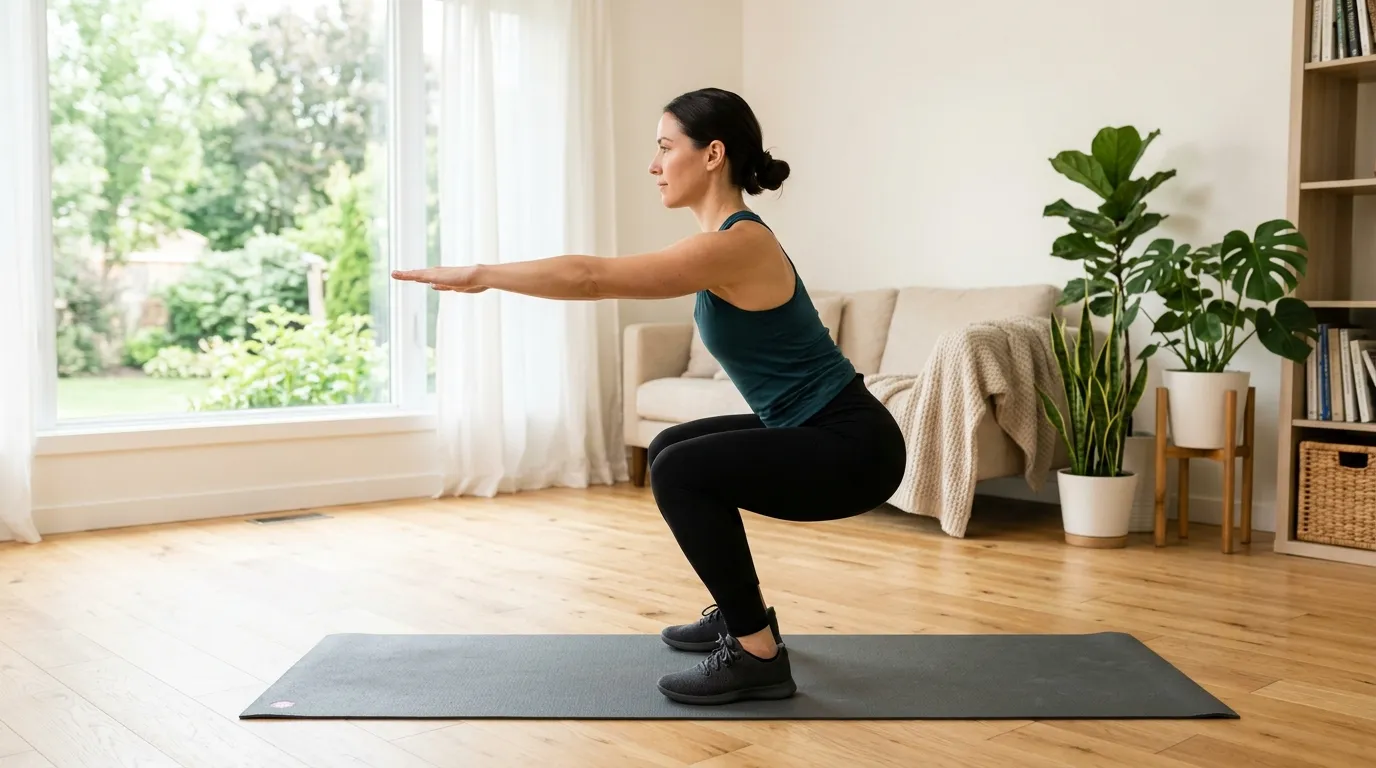
- Squat (Targets quads, glutes, and hamstrings): The basic bodyweight squat is the foundation of lower-body strength. It mimics the motion of sitting in a chair.
- Hinge (Targets hamstrings and glutes): The glute bridge is a fantastic hinge movement you can do lying on your back. It isolates the glutes and is great for posture, especially if you sit a lot.
- Lunge (Targets legs and glutes individually): Lunges are a unilateral movement, meaning they work one leg at a time. This is excellent for improving balance and ironing out strength differences between your left and right sides.
- Push (Targets chest, shoulders, and triceps): The classic push-up is the king of upper-body pushing exercises. You can modify it by doing it on your knees or against a wall to match your current strength level.
- Pull (Targets back and biceps): This is the trickiest pattern to train without equipment. However, exercises like the "Superman" or prone "Swimmers" are excellent for activating the muscles in your upper and lower back. While they don't build big muscles like a pull-up, they are crucial for posture and shoulder health.
- Core (Targets abs and lower back): The plank is a perfect example of a core stability exercise. It teaches you to brace your entire midsection, which protects your spine and improves your strength in all other lifts.
What's a great full-body bodyweight workout I can do today?
Here is a simple yet challenging full-body workout you can do right now with no equipment, designed to hit all your major muscle groups in about 30 minutes. It’s built on the foundational movements we just talked about. Remember to focus on quality over quantity!
Warm-Up (3-5 minutes): Get your blood flowing with some light movement. Try 30 seconds each of jumping jacks, high knees, arm circles, and leg swings.
The Workout:
Complete 3 sets of the following circuit. Rest for 60-90 seconds after you've completed all six exercises, then begin the next set.
- Bodyweight Squats: 12-15 reps. Keep your chest up and sit your hips back and down.
- Push-ups: 8-12 reps. Perform these on your toes or on your knees. Lower your chest toward the floor with control.
- Alternating Reverse Lunges: 10-12 reps per leg. Step one foot back and lower both knees to about 90-degree angles.
- Glute Bridges: 15-20 reps. Lie on your back with knees bent, and lift your hips toward the ceiling, squeezing your glutes at the top.
- Plank: Hold for 30-45 seconds. Keep your body in a straight line from your head to your heels, engaging your core.
- Supermans: 12-15 reps. Lie on your stomach and gently lift your arms, chest, and legs off the floor, squeezing your back muscles.
Note for beginners: If you're just starting out, aim for 2 sets instead of 3. If any exercise feels too challenging, reduce the number of reps. The most important thing is to move with good form and listen to your body. As you get stronger, you can work your way up to the full three sets.
Cool-Down (3-5 minutes): Finish with some gentle stretching for your major muscle groups, like a quad stretch, hamstring stretch, and chest stretch.
How do I keep making progress without weights?
To continue building strength without weights, you need to apply 'progressive overload,' which simply means finding ways to consistently challenge your muscles more over time. When you can no longer just add more weight to a bar, you have to get a little creative. Luckily, there are many ways to make a bodyweight workout no equipment plan harder as you get stronger.
- Add Reps or Sets: The most straightforward method. If you did 10 squats last week, try for 12 this week. Once you can complete all your sets and reps with good form, you can add another set.
- Slow Down the Tempo: This is a game-changer. Try lowering into your squat for a slow count of three, pausing for a second at the bottom, and then coming up. This increases the time your muscles are under tension, which stimulates growth.
- Reduce Rest Time: If you normally rest 90 seconds between sets, try cutting it to 75 or 60 seconds. This increases the metabolic demand of the workout.
- Increase Range of Motion: Work on getting just a little deeper into your squats and lunges (while always maintaining good form and avoiding pain). A greater range of motion makes the exercise more challenging.
- Progress to Harder Variations: This is the most powerful tool in your toolbox. Once you master a basic movement, you can move to a more advanced version. For example: Bodyweight Squat → Pause Squat → Single-Leg Squat. Knee Push-up → Full Push-up → Incline Push-up (feet elevated).
By using these techniques, you can ensure your body is always adapting and getting stronger, proving you don't need a gym full of equipment to make incredible progress.
How can I stay consistent when I'm busy and tired?
Consistency comes from creating a realistic routine and focusing on small, achievable actions, not from trying to be perfect every day. Life is busy, and motivation will come and go. The secret is to build a habit that can survive even on your most tired days.
First, start smaller than you think you need to. The goal isn't to do a perfect, hour-long workout from day one. It's to build the habit of showing up. The Physical Activity Guidelines for Americans recommend muscle-strengthening activities on 2 or more days a week. So, start there! Commit to just two 20-minute sessions per week.
Next, schedule it. Treat your workout like an important appointment. Put it in your calendar, set a reminder, and protect that time. Trying to squeeze it in "when you have time" is a recipe for it never happening.
Finally, focus on how exercise makes you feel, not just how it makes you look. Pay attention to that boost of energy after a workout, the feeling of accomplishment, or how much better you sleep. These immediate, positive feelings are powerful reinforcement for the new habit.
Try this week:
- Pick two days you will move your body for 20 minutes.
- Write them in your calendar right now.
- Lay out your workout clothes the night before.
- Do the workout in this post. That's it!
How does Madison Hansen Health Coaching create at-home training plans?
At Madison Hansen Health Coaching, I design custom training plans for busy women that are built entirely around their schedule, experience level, and available equipment, including effective bodyweight workout no equipment programs. I know from my 7+ years of coaching that a generic PDF or workout app rarely leads to lasting change. Real results come from a plan that truly fits your life.
That's why in my 12 Week Transformation program, every single training plan is built by me, a NASM Certified Health Coach, specifically for you. We'll start with where you are right now. If that means a 15-minute bodyweight routine in your living room three times a week, that's what we'll do. The plan is designed to be effective, not overwhelming.
This isn't an automated service; it's real one-on-one human coaching. Through weekly check-ins and direct messaging, we'll monitor your progress, celebrate your wins, and adjust your plan as you get stronger. This continuous support and personalization is what helps you build consistency and see the results you've been looking for.
Starting a fitness routine doesn't have to be complicated or stressful. You have everything you need to begin right now. If you're looking for more guidance and a personalized plan that fits your life, I'm here to help. You can explore my coaching programs or book a free, no-pressure 20-minute discovery call to chat about your goals. For a great first step you can take today, download my Free 5-Day Health Reset guide.
Frequently Asked Questions
Can you actually build muscle with only bodyweight training?+
Yes! You can build muscle by applying progressive overload. This means gradually making your workouts more challenging by increasing reps, slowing down your movements, or moving to harder exercise variations as you get stronger.
How often should I do bodyweight exercises to see results?+
For muscle-strengthening, aiming for 2-3 sessions per week on non-consecutive days is a great goal. This gives your muscles time to recover and grow stronger, which is essential for seeing results.
How long should a bodyweight workout be?+
It depends on your fitness level and schedule. A focused 20-30 minute session can be incredibly effective. The key is consistency, not duration. Even a 10-minute workout is far better than skipping it altogether.
Is bodyweight training effective for weight management?+
Absolutely. Bodyweight workouts burn calories and, more importantly, build muscle. The more muscle you have, the more calories your body burns at rest. When combined with supportive nutrition, it's a powerful tool for managing weight sustainably.