The Ultimate Dumbbell Workout at Home for Women
Tired of workouts that don't fit your busy life? Discover an effective full-body dumbbell workout at home for women. This guide covers everything you need to know to build strength, tone muscle, and create a routine that sticks, no gym required.
Why is a Dumbbell Workout at Home for Women So Effective?
A dumbbell workout at home for women is incredibly effective because it combines convenience with the proven benefits of strength training, helping you build lean muscle, boost your metabolism, and improve bone density without needing a gym. It's one of the most versatile and accessible ways to get stronger on your own schedule.
As a health coach, I've seen hundreds of women transform their bodies and their confidence using simple tools like dumbbells. The magic isn't in some complicated machine; it's in consistently challenging your muscles. When you lift weights, you create tiny micro-tears in your muscle fibers. Your body then repairs and rebuilds them stronger than before. This process not only creates toned, defined muscles but also turns your body into a more efficient calorie-burning engine, even at rest.
One of the biggest concerns I hear is, "But Maddie, I don't want to get bulky!" Let me put that fear to rest. Due to hormonal differences, particularly lower levels of testosterone, women do not build large, bulky muscles in the same way men do. Instead, strength training with dumbbells helps create a leaner, more sculpted physique. You get the strength and the shape without the bulk.
Beyond aesthetics, the health benefits are immense. The National Institutes of Health emphasizes that strength training is crucial for building and maintaining bone density, which helps protect against osteoporosis, a condition that disproportionately affects women. It also improves your heart health, helps regulate blood sugar, and makes everyday activities—like carrying groceries or playing with your kids—feel so much easier.
How Do I Choose the Right Dumbbells?
You should choose a dumbbell weight that allows you to complete your target number of repetitions (reps) with good form, where the last two or three reps feel challenging but are still possible. For most women starting out, a pair of 5-pound and 10-pound dumbbells is a great starting point.
There's no single "perfect" weight, because different exercises and different muscle groups require different loads. Your legs are much stronger than your shoulders, so you'll naturally be able to squat with more weight than you can use for an overhead press. That's why having a couple of options is ideal.
Here’s a simple test to see if you have the right weight:
- Pick up the dumbbell and perform the exercise for your target rep range (let's say 12 reps).
- If you can easily perform all 12 reps and feel like you could do 5 more, the weight is likely too light.
- If you can't complete at least 8 reps without your form breaking down (e.g., swinging your body or arching your back), the weight is too heavy.
- If you can complete about 10-12 reps and the last couple are a real struggle, you've found your sweet spot.
Don't be afraid to start light and focus on mastering the movement. Proper form is always more important than lifting heavy. As you get stronger, you'll find you can complete more reps with ease. That's your cue to increase the weight! This principle, called progressive overload, is the key to making continuous progress.
What's a Good Full-Body Dumbbell Workout I Can Do?
A great full-body dumbbell workout includes compound movements that work multiple muscle groups at once, making your routine efficient and effective. This workout is designed to hit all your major muscles and can be done in about 30-40 minutes, two to three times a week on non-consecutive days.
Before you start, always warm up for 5-10 minutes with some light cardio (like jogging in place or jumping jacks) and dynamic stretches (like arm circles and leg swings) to get your blood flowing and prepare your joints.
Here is a simple yet powerful dumbbell workout at home for women:
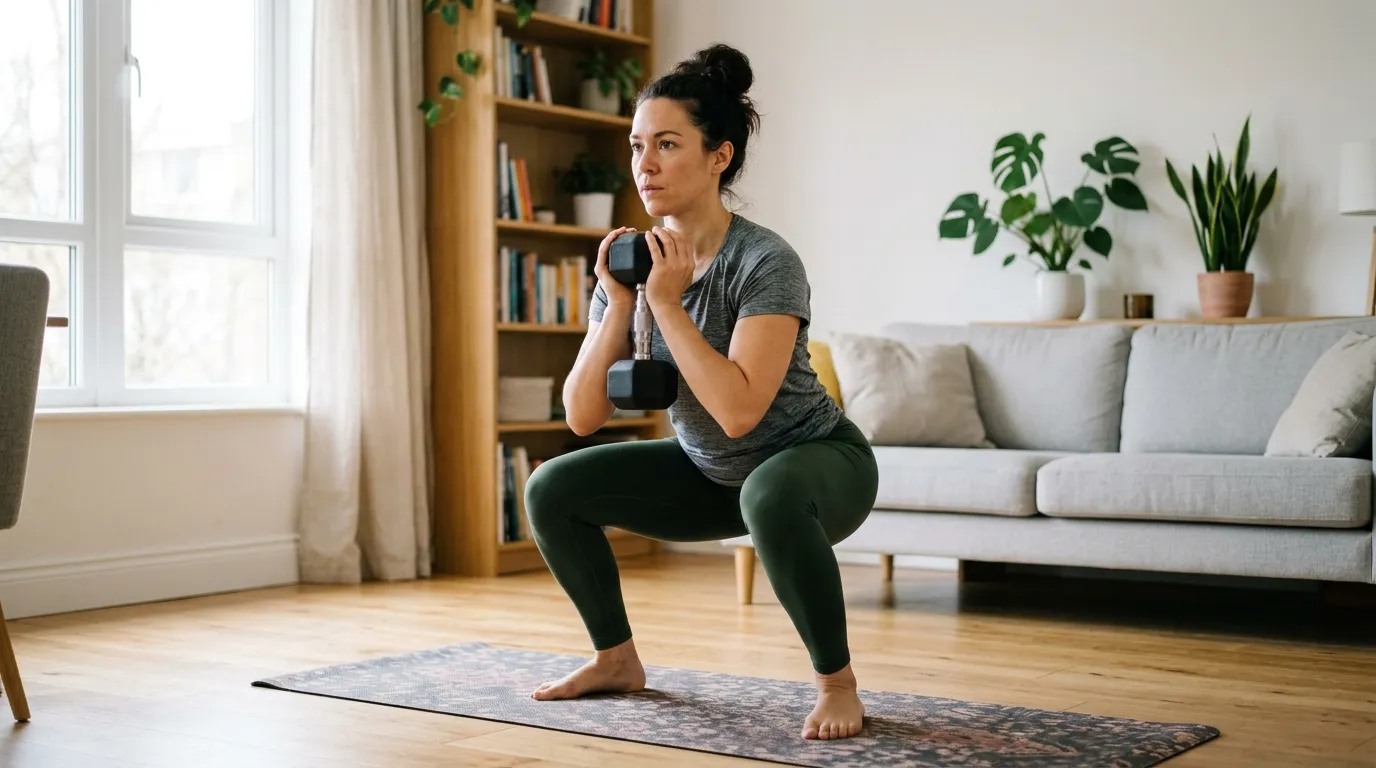
- Goblet Squats (3 sets of 10-12 reps): Hold one dumbbell vertically against your chest with both hands. Stand with your feet shoulder-width apart. Lower your hips back and down as if sitting in a chair, keeping your chest up and back straight. Go as low as you comfortably can, then push through your heels to return to the starting position.
- Bent-Over Rows (3 sets of 10-12 reps per side): Hold a dumbbell in one hand. Hinge at your hips, keeping your back straight until your torso is nearly parallel to the floor. Let the dumbbell hang towards the floor. Pull the dumbbell up towards your chest, squeezing your back muscles. Lower it with control and repeat.
- Dumbbell Chest Press (3 sets of 10-12 reps): Lie on your back on the floor or a bench with your knees bent and feet flat. Hold a dumbbell in each hand at your chest, with your palms facing forward. Press the dumbbells straight up until your arms are fully extended, but not locked. Lower them back down slowly.
- Reverse Lunges (3 sets of 10-12 reps per side): Stand tall, holding a dumbbell in each hand at your sides. Step one foot straight back, lowering both knees to a 90-degree angle. Your front knee should be aligned with your ankle, and your back knee should hover just above the ground. Push off your back foot to return to standing.
- Overhead Press (3 sets of 10-12 reps): Sit or stand tall, holding a dumbbell in each hand at shoulder height, palms facing forward. Engage your core and press the dumbbells directly overhead until your arms are fully extended. Lower them back to your shoulders with control.
- Glute Bridges (3 sets of 15 reps): Lie on your back with your knees bent, feet flat on the floor close to your glutes. Place one dumbbell across your hips. Drive through your heels and lift your hips toward the ceiling, squeezing your glutes at the top. Lower back down slowly.
Note for beginners: Start with a lighter weight, or even just your bodyweight, to master the form. You can begin with 2 sets of 8-10 reps and gradually build up to 3 sets of 12.
Try This Week
- Schedule two 30-minute workout sessions in your calendar right now. Treat them like important appointments.
- Perform the workout above, focusing entirely on your form. Use a mirror or record yourself to check your technique.
- After each workout, take a moment to notice how you feel. Strong? Accomplished? Write it down to build positive momentum.
How Can I Make Sure My Form is Correct and Safe?
Ensuring correct and safe form is the most important part of any workout, as it prevents injury and makes sure you're actually working the intended muscles. The key is to move with intention and control, rather than rushing through the exercises.
Here are my top tips for maintaining great form:
- Engage Your Core: Before you lift, brace your abdominal muscles as if you're about to be punched in the stomach. This stabilizes your spine and provides a solid foundation for every movement.
- Move Slowly and Deliberately: Avoid using momentum to swing the weights. A good rule of thumb is to take two seconds to lift the weight and three to four seconds to lower it. The lowering (eccentric) phase is just as important for building strength.
- Keep a Neutral Spine: Whether you're squatting, rowing, or pressing, try to maintain a straight line from your head to your tailbone. Avoid rounding or excessively arching your back.
- Breathe: It's a common mistake to hold your breath. Exhale during the hardest part of the movement (the exertion, like pressing the weight up) and inhale as you return to the start.
- Listen to Your Body: There's a difference between the burn of muscle fatigue and the sharp, stabbing signal of pain. Muscle soreness after a workout is normal, but if you feel any sharp pain during an exercise, stop immediately. If pain persists, it's always best to consult with a doctor or physical therapist.
Setting up a safe workout space is also crucial. Make sure you have a clear, flat area to move in, free of tripping hazards. An exercise mat can provide some cushioning and stability on hard floors.
How Madison Hansen Health Coaching Creates Home Workouts
At Madison Hansen Health Coaching, I build personalized training plans that are designed to work for your real life, whether you have a full gym or just a single pair of dumbbells at home. My 12 Week Transformation program is built entirely around your schedule, experience level, and available equipment, ensuring you get an effective workout without the stress.
As a certified Health Coach with specializations in nutrition and behavior change, I understand that a plan is only good if you can stick with it. That's why I provide real, one-on-one human coaching—not an app or a bot. We'll have weekly check-ins to monitor your progress, adjust your plan as you get stronger, and work through any challenges you face. It’s about teaching you the lasting skills and habits you need to maintain your results long after our coaching relationship ends. My goal is for you to feel confident and capable in your fitness journey.
If you're tired of generic plans that don't fit your life, I encourage you to explore my coaching programs. Or, if you're not sure where to start, you can download my Free 5-Day Health Reset for a taste of my practical, sustainable approach. Ready to talk about your goals? Let's chat! You can book a free, no-pressure 20-minute discovery call to see if we're a good fit.
Frequently Asked Questions
Will lifting dumbbells make me bulky?+
No, it's a common myth. Due to women having significantly lower levels of testosterone than men, it is very difficult to build large, bulky muscles. Instead, consistent strength training with dumbbells typically leads to a leaner, more toned, and stronger physique.
How often should I do a dumbbell workout at home?+
For beginners, performing a full-body dumbbell workout 2-3 times per week on non-consecutive days is highly effective. This schedule allows your muscles adequate time to rest and recover, which is when they actually grow stronger.
What weight dumbbells should a beginner woman use?+
A great starting point for most beginner women is a pair of 5 lb and 10 lb dumbbells. The right weight is one that allows you to complete 10-12 repetitions with good form, where the last few reps feel challenging but possible. You may need different weights for different exercises.
Is it better to do a full-body workout or split my days?+
For beginners, full-body workouts are generally recommended. They are time-efficient and ensure you're hitting all major muscle groups frequently enough to build a solid foundation of strength. As you become more advanced, you might consider splitting your workouts to focus on specific muscle groups on different days.